
Over the past three years, since 2023, our team has been actively involved in the management and implementation of a project aimed at increasing the adaptive capacity of future young forests in the Regetovka area- Eastern Slovakia. In close collaboration with local forest owners, we have succeeded in increasing the species diversity of young stands over an area of 14.85 hectares.
For our team, this project represented a professional challenge as well as an opportunity to restore forests with a unique and complex history. The affected stands were originally spruce forests that suffered extensive damage from snow, wind, drought, and bark beetle calamities. At the same time, these locations were influenced by so-called melioration interventions carried out in the 1980s, during which part of the humus layer of the soil was removed. As a result, today we have shallow and acidic soils with limited production potential for future spruce stands.
Although spruce naturally regenerates in the area, its long-term stability under these site conditions is low. Therefore, we focused on increasing the proportion of deciduous trees. Young stands were established by planting European beech, white fir, mountain maple, and mountain elm. At the same time, we carried out site preparation and stand management to support successful afforestation and natural regeneration.
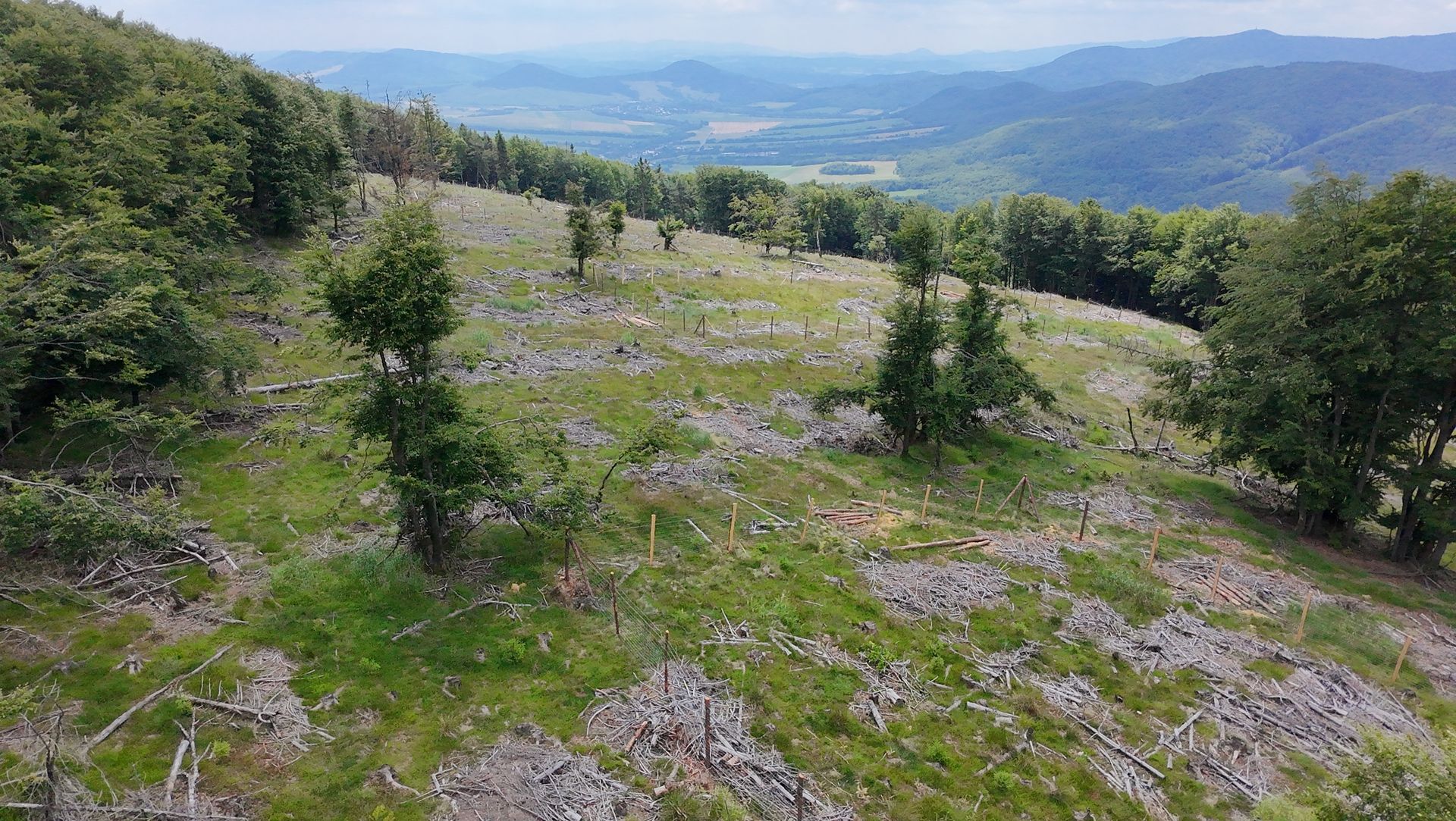
A key component of the project was the construction of small-scale enclosures. Over an area of more than 4 hectares, protective fences were built to ensure the natural regeneration of previously established larch stands, as well as newly planted trees. This measure was necessary due to the high density of wildlife in the area, which poses a significant risk to the development of young stands.
We actively managed the remaining parent stands in parallel to stabilize their structure and prevent further creation of extensive clearings. This helped to halt further degradation and support the gradual restoration of forest ecosystems.
The results are visible already today. After two years, the fenced areas show a significant increase in the share of natural regeneration, especially of so-called pioneer species such as birch, rowan, and pine. This spontaneous regeneration additionally improves soil conditions, increases overall species diversity, and contributes to the creation of structurally rich and resilient young forests.
Thanks to intensive collaboration with partners and local forest owners, the project laid the foundations for stable, species-rich, and climate-resilient forests for future generations.
The project was co-financed by the European Union through the Rural Development Program.